HTML5 & Multi-Touch on the Web
[The following is a technical preview of our work with HTML5. We estimate commercial availability in late 2012. For a video of the work in action, click here.]
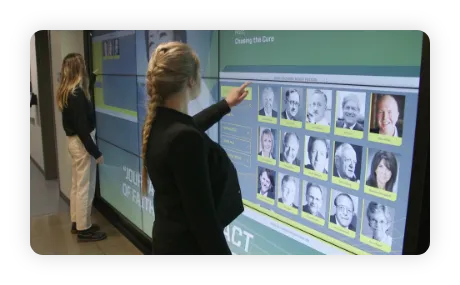
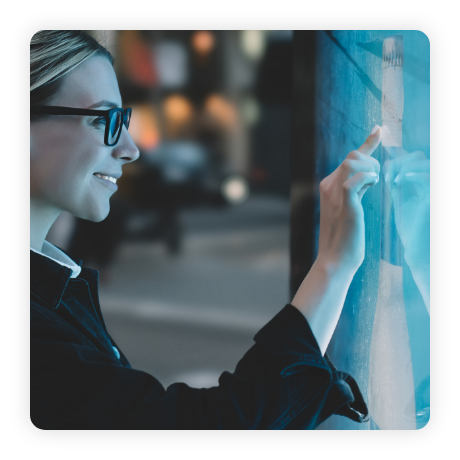
Introducing the Web as a multi-touch application hosting option opens the door to instant availability and universal access, giving retailers, advertisers and the like a powerful new medium for communicating with their prospects and customers. Web designers and their clients will be able to create immersive Web experiences without requiring plug-in downloads or excessive cross-browser scripting to ensure compatibility. Interactive mobile phone experiences could be ported to the Web, establishing a consistent look-and-feel, and then expanded to take advantage of additional screen real estate. Ambitious retailers, hospitality vendors and the like could take things a step further and carry over the phone and Web experience to their stores, lobbies and gathering places through interactive tablets, kiosks, tables and touchscreen walls.
Until recently this has not been possible because the lingua franca of the Web – HTML – did not recognize manual gestures. This meant Web browsers on touchscreen devices reacted to manual interaction as if they were simple mouse events, limiting responses to page scrolling and link clicks.
|
HTML5 and its Touch Events API changes the game. Web browsers supporting HTML5 are able to identify touch events, recording their location, movement, etc. These events can be used by Web developers to create dynamic, multi-touch experiences that will work on any Web browser. Such browser independence also means device independence. The result is a low footprint multi-touch experience built once and run everywhere. |
Well, that’s the promise.
In practice, the W3C Touch Events API is still a working draft and thus modern browsers have uneven levels of implementation of this standard: mobile browsers (iOS Safari, Android browser, Firefox Mobile) are leading the way in touch support whereas desktop browsers still lack even basic touch support (Chrome, Opera, IE9) or have implemented their own API (IE10, Firefox).
Furthermore, solving the touch event problem is necessary but insufficient. One must also build a Web application that takes advantage of touch events and this can be difficult. Worse, this difficulty increases with the number of simultaneous touch events. The fact is, designing multi-touch interactions is quite different and more difficult than designing mouse interactions. As a result, the various demonstrations of in-the-browser multi-touch now on the Web are typically limited to one object interaction at a time and to no more than two simultaneous touches. This limits design creativity and thus the ability to create immersive experiences in the browser. It is here that IntuiLab has focused its latest R&D efforts.
IntuiLab pursues natural user interaction (NUI) innovation both on the design side – i.e. the creation of NUI applications – as well as on the execution side – i.e. creating smooth, real-time visual feedback. In the context of HTML5, our goal is create a rich client experience on the Web. This means the ability to interact with multiple objects simultaneously, using multiple fingers to perform multi-touch gestures in any Web browser and on any touch device – or as we say, massive multi-touch. Our customers are already familiar with this experience via our rich client Player.
To achieve massive multi-touch on the Web requires:
- Properly formatted webpages configured to accommodate interactive object movement
- A listening engine for HTML5 touch events that hides the differences between browsers
- An execution engine that can both translate & interpret touch events as well as execute the resulting graphical actions
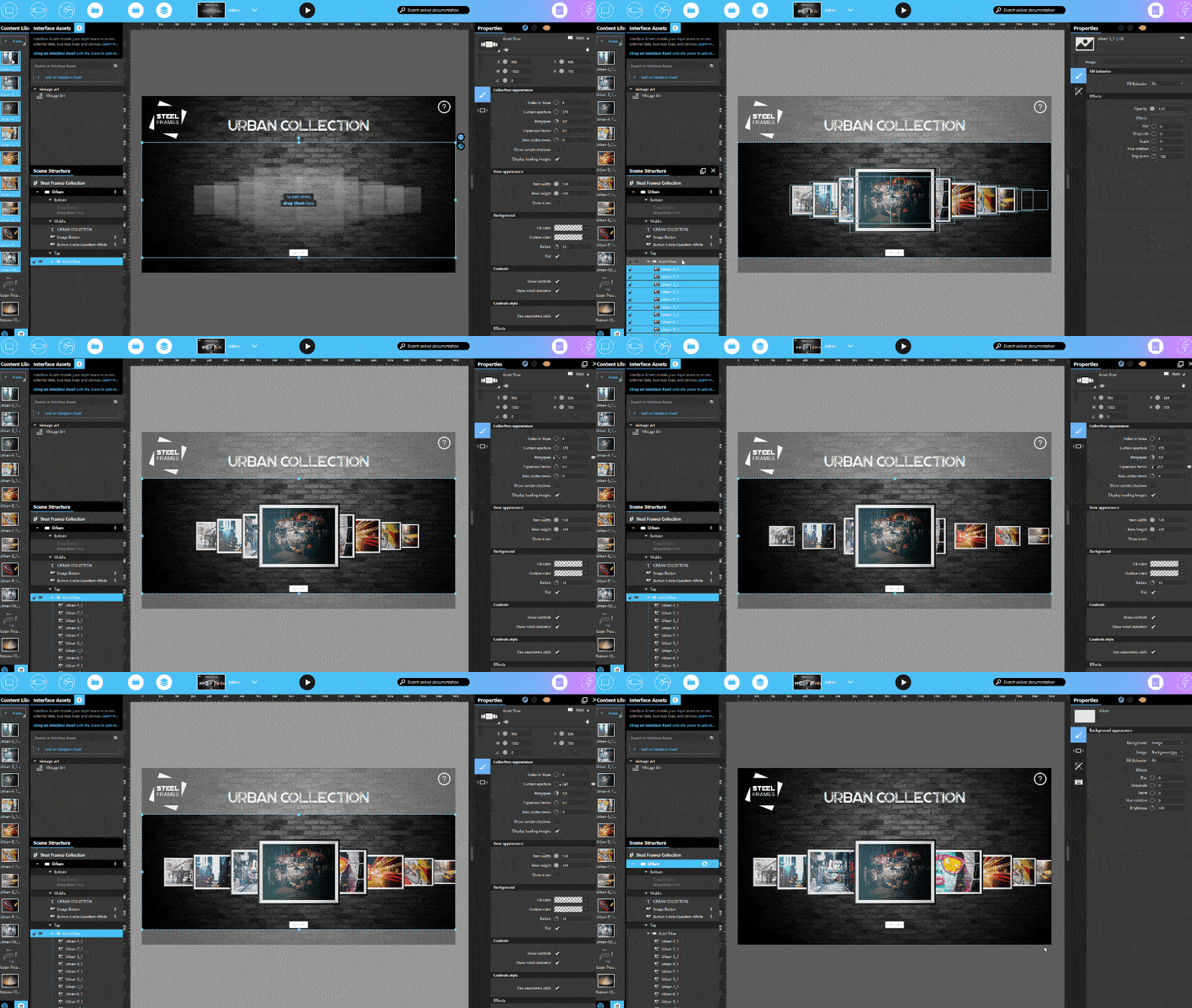
By applying the same algorithmic principles first developed for our IntuiFace Commerce rich client, technology published in the patent we filed in 2008, IntuiLab has built design and execution extensions for on-the-Web multi-touch. The following video illustrates this development in action:
As illustrated in the video, the workflow for creation and deployment of a browser-based multi-touch application will be:
- Application creation in IntuiFace Presentation or in IntuiFace Commerce.
- The process will be identical to that used for creating multi-touch applications intended for rich client use.
- There will be no content limitations. Use any image, video, document, map, etc. and any of our design elements.
- Deployment to IntuiLab’s in-the-cloud multi-touch application hosting solution, assigning a URL to each deployed application.
- Connect to the hosting website from any Web browser on any device and select the application of interest.
- Interact with the selected application in your browser as intended.
HTML5 expands the reach and availability of multi-touch experiences. IntuiLab is dedicated to innovation in this area and is excited to bring it to market in 2012.